October 02, 2026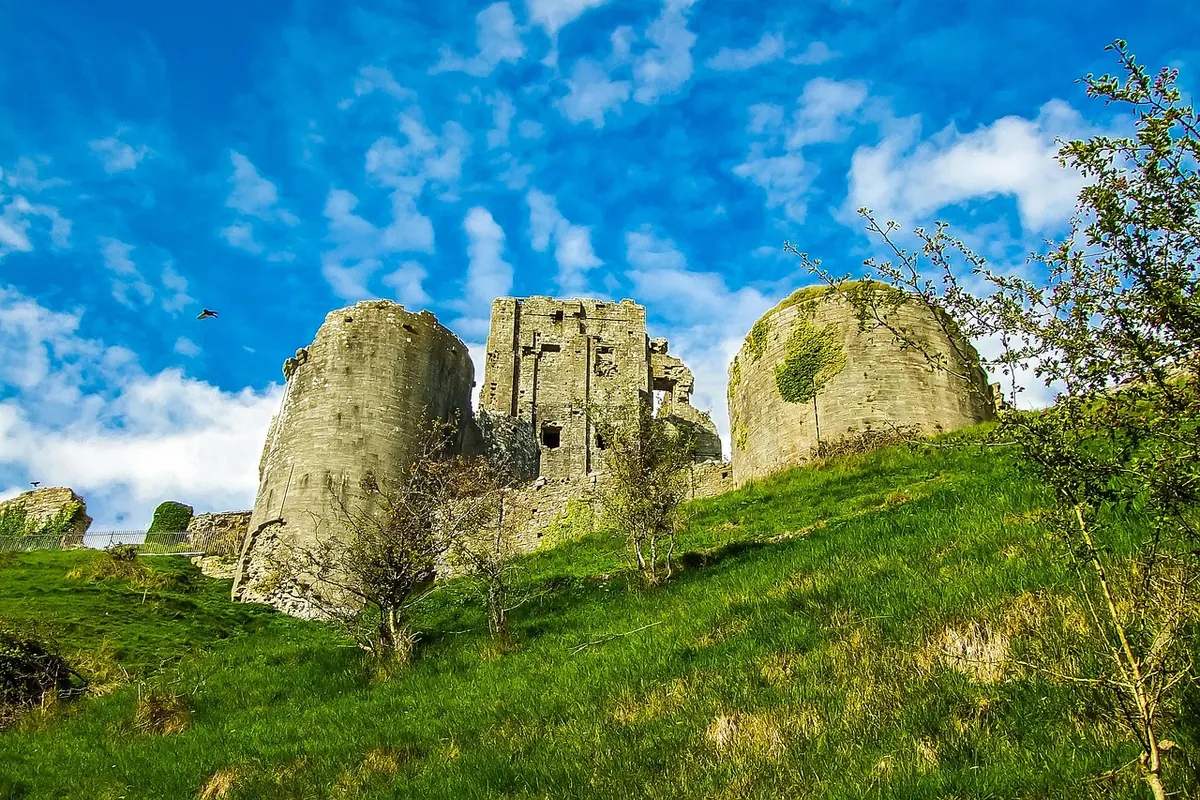
You spot it long before you reach it: a broken tower standing in a notch in the Purbeck hills, with a village of grey stone houses gathered underneath. Corfe is one of those places where the castle and the landscape tell the same story. The name gives it away — corf is Old English for a gap or cutting in the hills — and for a thousand years anyone crossing the Isle of Purbeck has had to come through this pass. That is exactly why kings built here, and why, for one hard winter in the 1640s, much of England was waiting to hear what happened next.
A Gap Worth Guarding: Saxon Corfe
Long before any stone was laid, this was a royal spot. By the tenth century there was a Saxon royal residence at Corfe, and it was important enough to have its own mint — coins were struck here in the reign of Æthelred II. The surrounding Purbeck heath made excellent hunting country, which mattered more to a Saxon king than almost anything else.
The murder of Edward the Martyr
Corfe's most famous early moment is a grim one. In March 978, the teenage King Edward was killed while visiting the royal site here, and the blame fell on the household of his stepmother, Ælfthryth, whose son Æthelred then took the throne. Edward was later made a saint, and a stone shaft by the churchyard in the village is traditionally said to mark the place where he died. It is a strange feeling, standing in a quiet churchyard beside a story that reshaped the English crown.
The Normans Build in Stone
After 1066 the new Norman kings took the site over and gave it the shape you see today. The first earthwork defences went up at the end of the eleventh century, and the great stone keep — still the landmark on the skyline — was raised in the early twelfth century, most likely under Henry I. Two baileys spread out below it, with a gatehouse controlling the road through the gap.
From then on Corfe was a working royal castle rather than a decorative one. It held treasure, it stored supplies, and it held people. Its distance from London made escape difficult, so it served as a prison for important captives. King John was a frequent presence, and he spent money on the place; later medieval kings added towers and comfortable lodgings, including a small private tower known as the Gloriette where a king could stay in some style.
A castle of queens and princes
Through the fourteenth century Corfe was passed around the royal family, attached for long periods to the earldom — later the duchy — of Cornwall. That meant it belonged to whoever the crown decided should hold it, and castles held in that way tend to be maintained while they matter and quietly neglected when they don't. By the Tudor period Corfe was no longer a serious fortress. Elizabeth I gave it to Sir Christopher Hatton in 1572, and in 1635 it was sold to Sir John Bankes, Attorney General to Charles I, whose family would end up shaping its fate.
The Bankes family made the old castle comfortable again, turning parts of it into a country house. For a few decades it was a home rather than a stronghold. That did not last.
The Civil War and the Two Sieges
When the country split in 1642, Dorset leaned towards Parliament, but Corfe Castle held for the king — and Sir John Bankes was away, serving Charles I. The defence fell to his wife, Lady Mary Bankes, and she proved to be the most stubborn commander in the castle's long history.
A Parliamentary force besieged Corfe in 1643 and got nowhere. The castle's position, high on the hill with steep approaches, made it a horrible target. The second siege, from late 1645 into early 1646, was a longer and colder business, and it ended not in battle but in betrayal: a member of the garrison let the enemy in. The Parliamentarians took the castle, and they made sure it could never be used again. By order of Parliament, Corfe was slighted — deliberately wrecked, with gunpowder used to topple walls and bring the keep down into the ruin you see today. Lady Mary is said to have kept the castle keys. It is easy to see why the story stuck.
The Bankes family kept the estate, and the shattered castle became a romantic landmark long before it became a tourist one. In 1982 the family gave Corfe Castle and nearby Kingston Lacy to the National Trust, which looks after both today.
What to See Today
The ruins are extensive, and it is worth taking your time rather than marching straight up to the keep and back down again.
- The keep. Climb inside it if the weather allows. The walls lean at angles that look impossible, and the views over the Purbeck ridge and out towards Poole Harbour explain why anyone bothered building here.
- The gatehouse and west bailey. Look for the lines where different centuries of building meet — Norman stonework, medieval additions, and the scars left by the slighting.
- The murder stone. In the village, by the churchyard of St Edward's, marking the traditional site of Edward the Martyr's death in 978.
- St Edward's Church. Its tower was reportedly used as a gun platform by the besiegers in the 1640s, which must have made for awkward relations with the castle's defenders. The church holds Bankes family memorials.
- The view from East Hill. A short but steep walk gives you the classic photograph of castle and village together.
- The model village. A miniature version of Corfe as it looked before the Civil War — useful for working out what you have just been looking at.
Practical Notes for Your Visit
Corfe Castle village sits on the A351 between Wareham and Swanage. Wareham, about five miles away, is the nearest town and has the closest mainline railway station. The Swanage Railway runs steam trains through Corfe Castle station, which is a genuinely good way to arrive if you are staying in Swanage.
Parking in the village is limited and fills quickly in summer. The National Trust car park is right by the castle entrance, and there is another in the village. Arrive before mid-morning or after about three in the afternoon if you want an easier time of it.
The walk from the village up to the castle is short but steep, with uneven cobbles and steps. Wear shoes with proper grip — trainers are fine, smooth soles are not. The castle sometimes closes at short notice in high winds, so check opening times the day before you travel, and check again if the forecast is rough. Dogs are welcome on leads. There is a tearoom in the village and a couple of pubs, so you can build a half-day around the visit without much planning.
Photo: diego_torres / Pixabay