October 11, 2026
Maiden Castle is not a castle, and nobody has ever convincingly identified the maiden. The name is usually traced to a Brittonic phrase meaning something like "the great hill", which is at least honest. What sits two miles southwest of Dorchester is the largest Iron Age hillfort in Britain: a long chalk ridge crowned with ramparts that stack nearly twenty metres from ditch floor to bank top in places. You can see the whole thing from the A354 and still be unprepared for it when you walk in.
Getting There and Starting Out
The fort lies just off the Weymouth road out of Dorchester. There is a small English Heritage car park at the foot of the hill, signposted from the A354, and it is free. It fills up on sunny bank holidays and almost never otherwise.
Buses along the Weymouth road will drop you within a short walk of the entrance. If you are coming from Dorchester on foot, it is a straightforward forty minutes or so from the town centre, following the road that carries the fort's name and then a footpath across the fields.
There is no visitor centre, no ticket office and no closing gate. Entry is free and the site is open during daylight hours. English Heritage looks after it, but you will mostly have the place to yourself outside school holidays.
The Climb: Short, Steep, Over Quickly
From the car park, a path leads towards the eastern gateway and then up. The pull is steep for perhaps five minutes, and that is the whole of it — once you are through the entrance the interior is broad and flat. The chalk is slippery after rain and loose and dusty in a dry August, so shoes with a tread matter more than you would think on a hill this modest.
If you would rather not climb straight up the middle, you can follow the ramparts instead. The full circuit of the defences is a little over a mile and a half, with two or three sharper pulls where the entrances cut through the banks.
Reading the Earthworks
Most first-time visitors walk up, look at the view and walk back down. Give it another twenty minutes and the site starts to make sense.
- The eastern entrance. This is the most complicated piece of engineering on the hill. Several banks and ditches stagger the approach, so anyone attacking had to turn, drop and funnel rather than charge.
- The multiple ramparts. The fort was rebuilt and strengthened more than once. What you see is layers of work, not a single design.
- The long barrow. A low, elongated mound near the western end of the interior. It was already ancient when the hillfort was built.
- The Romano-Celtic temple. A small square foundation in the eastern part of the interior, raised long after the fort was abandoned.
- The lynchets. Terraces on the slopes outside the ramparts, left behind by centuries of ploughing.
Walk the inside edge of the bank and look outwards rather than inwards. From there you can see how the entrances were designed to be watched, and how much of the surrounding country the people who built this could see and be seen from.
Three Thousand Years on One Hill
The story starts well before the Iron Age. A Neolithic causewayed enclosure — a circuit of interrupted ditches — was dug on the hilltop around 3500 BC, and the long barrow followed. Then there is a long pause, and the first hillfort rampart appears somewhere around 600 BC.
The fort grew and was remodelled over the following centuries. In the first century BC the eastern entrance was rebuilt on a much grander scale, and the interior filled with roundhouses, storage pits and workshops. Excavations have turned up grain, loom weights, quern stones and animal bone — the ordinary furniture of a busy settlement, not a remote refuge.
Then Rome arrived. Vespasian, later emperor, is recorded as taking hillforts in this part of Britain during the invasion of the 40s AD, and Maiden Castle is generally linked with that campaign. Excavations in the 1930s found a burial pit near the eastern entrance containing skeletons, one of them with an iron bolt lodged in a vertebra — usually read as evidence of the assault. After that, the hill emptied. A small temple was built inside it in the fourth century, and then nothing much for a very long time.
Walks From the Hillfort
The obvious outing is the short one: up from the car park, once around the ramparts, a wander through the interior, and back down. Allow an hour, more if the weather is good.
For something longer, the South Dorset Ridgeway runs along this chalk spine and can be picked up close to the fort. Heading west takes you deeper into empty downland; heading back east brings you into Dorchester, where the Dorset Museum holds finds from the site and makes a good pairing with a morning on the hill. To the southwest, footpaths drop towards Martinstown and on to Littlebredy, a quiet village loop that adds a couple of miles each way.
Practical Notes Before You Go
There are no toilets, no café and no water on site. The nearest of all three is in Dorchester, so plan accordingly.
The hill is exposed. Even on a still day in the town, there is usually a breeze on the ramparts, and there is no shade anywhere in the interior. Take water in summer and a windproof layer year-round. Sheep graze the site for much of the year, so keep dogs on a lead and close the gates behind you.
Resist the urge to scramble up and down the banks, particularly after rain. Chalk erodes quickly once the turf is broken, and these earthworks have survived two thousand years largely because people have kept off them.
Early morning and the last hour before dusk are the best times to come. The light rakes across the ditches, the shadows show you exactly what you are standing on, and you will often have the whole hill to yourself.
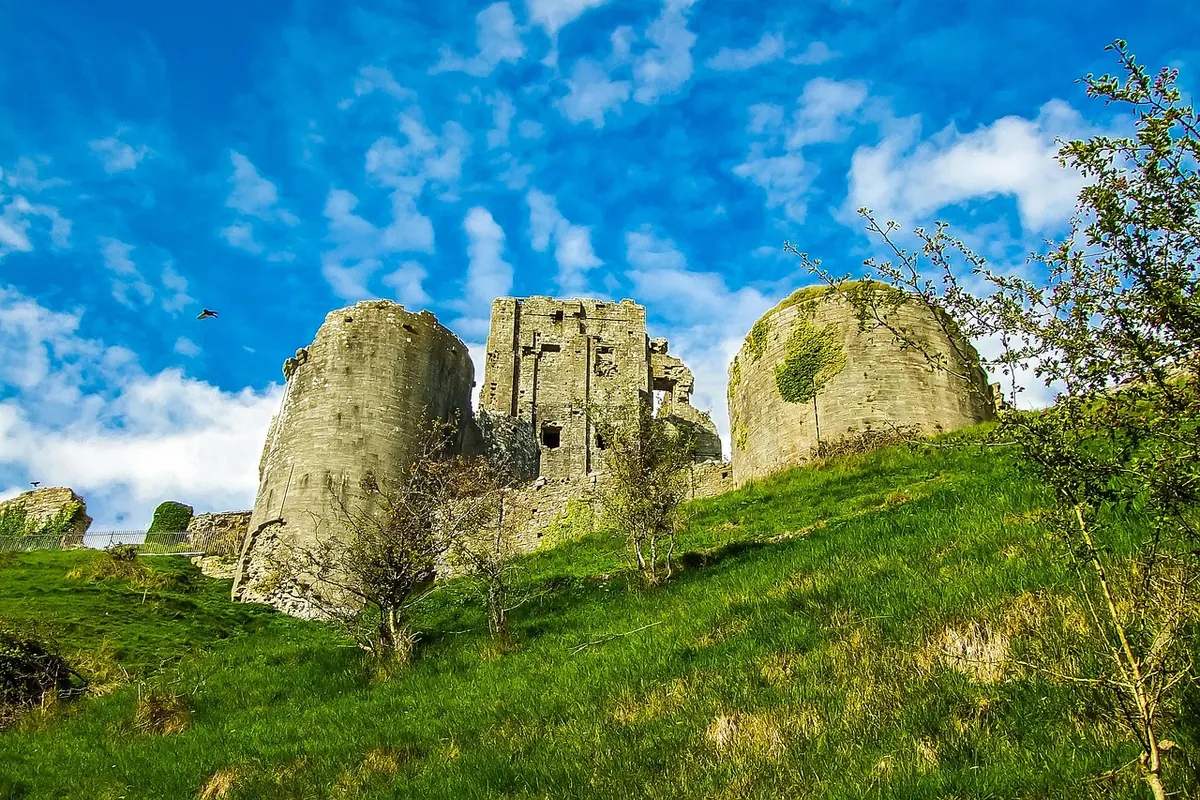
Photo: OtoZapletal / Pixabay